
Inside Ghana's Most Ambitious Missionary Training School: And Why It Matters for the Unreached World
By GlobeServe Ministries | Tamale, Northern Ghana
missionary training Africa, church planting Ghana, West Africa missions, unreached people groups, Muslim-majority outreach, discipleship training, School of Missions Ghana, indigenous missionaries
What happens when you train 14 people not just to share the Gospel, but to train others who train others, who in turn train others still? You get a movement that math alone cannot contain and that human ambition alone cannot produce.
That is the vision driving GlobeServe’s School of Missions and Church Planting in Tamale, Northern Ghana. It is one of the most strategically positioned and methodologically serious missionary training programs operating anywhere in West Africa today. And right now, 14 men and women are in the middle of it, being shaped into the kind of missionaries that Ghana and West Africa desperately need.
Why Tamale? The Geography of the Unreached
To understand why GlobeServe planted its School of Missions in Tamale, you have to understand the map.
Tamale is the capital of Ghana’s Northern Region, sitting at the geographic and cultural crossroads between two very different worlds. To the south lies Ghana’s Christian heartland, where churches are plentiful, the Gospel is culturally familiar, and evangelical Christianity has deep roots going back generations. To the north lies the Sahel: a vast, arid, semi-desert band stretching across the width of the African continent. The Sahel is home to some of the largest concentrations of unreached people on earth, including millions of Muslims in countries like Mali, Niger, Burkina Faso, and Mauritania who have little to no access to the Gospel in any meaningful form.
Tamale is a Muslim-majority city. Northern Ghana is one of the most underreached parts of the country. Planting a missionary training school here is not convenient. It is intentional. It sends a message that the Gospel belongs among the unreached, and that those who carry it should come from as close to the need as possible.
This is the principle of proximity. Workers trained in Tamale are already culturally adjacent to the communities they will enter. Many speak local languages natively. They understand the rhythms of Muslim community life, the social codes of northern Ghana, and the relational dynamics of village culture in the Sahel region. They do not need years of cultural orientation before they can be effective. They are already home.
Who Is Being Trained: The Current Cohort
The school’s current cohort of 14 students is now in month four of their program, well past initial orientation and deep into the intensive formation phase that actually shapes how a person thinks, prays, and ministers.
These are not passive students sitting in rows and taking notes. They are emerging disciple-makers actively being equipped across three core disciplines that define GlobeServe’s approach to frontier missions:
Discovery Bible Study (DBS): This is an inductive, group-based method of engaging Scripture that has proven remarkably effective in reaching oral-learner communities across the Muslim world and West Africa. Rather than a teacher delivering content to passive listeners, DBS invites participants to read or hear a passage of Scripture and answer guided questions together: What does this say? What does this mean? What will I do about it?
Celebration Church Planting: This is a model for establishing worshipping communities in resource-limited settings. Celebration Churches are designed to be planted by ordinary believers in ordinary homes, to be led by local elders from the beginning, and to plant daughter churches as a natural expression of health and growth.
Reaching Muslim-Majority Communities: This is perhaps the most nuanced and specialized component of the curriculum. Effective Gospel witness in Muslim contexts requires cultural sensitivity, theological understanding of Islamic belief and practice, relational patience, and a long-term commitment to trust-building that can span years before significant spiritual fruit appears. Students are equipped not just with techniques, but with the heart posture and theological clarity needed to love Muslim neighbors well and present the Gospel in ways that connect rather than alienate.
What is striking is that these are not merely classroom concepts. Students are already in the field. Internships are underway. Jesus Film backpacks have been deployed. The line between training and ministry has been deliberately blurred because effective formation happens in practice, not just in theory.
The Mathematics of Multiplication
The true scope of what the School of Missions is building becomes visible only when you think in terms of multiplication rather than addition.
If this batch of 14 students fulfills its potential over the next four years, the projected Kingdom impact looks like this:
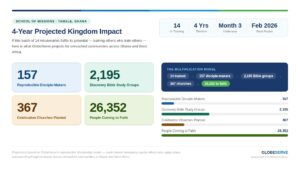
These projections are not wishful thinking. They are based on documented multiplication rates from similar programs operating in comparable contexts, where trained disciple-makers have consistently reproduced at rates that compound rapidly over time. Each disciple makes disciples. Each DBS group produces leaders who start new groups. Each church plants daughter churches. The math is exponential because the methodology is designed for reproduction.
The 14 students currently in formation in Tamale, if they multiply as trained, could catalyze 367 churches and over 26,000 new believers within four years. It is a simple observation about what happens when the right people are trained with the right methods in the right location.
What Makes This Different From Traditional Mission Training
The question worth asking is: what separates the School of Missions from a conventional Bible college or seminary?
The answer is reproducibility at every level.
Most traditional theological education trains students to become institutional leaders: pastors of congregations, leaders of organizations, teachers of classes. These are valuable and necessary roles. But they do not automatically produce multiplication. A seminary graduate who plants one church has done something genuinely good. A disciple-maker who trains twelve people who each train twelve more has started a movement.
GlobeServe’s curriculum is built around a fundamentally different question: not “What can this person lead?” but “What can this person teach someone else to do?” Every method in the training program is evaluated for how easily it can be passed on by a new believer to another new believer, with no additional outside input. If a method requires specialist knowledge, expensive equipment, or institutional support to function, it does not belong in the curriculum.
The Broader West Africa Context: Why This Region, Why Now
West Africa is one of the most spiritually significant regions in the world at this particular moment in history. The church is growing rapidly in many parts of sub-Saharan Africa, yet millions of people across the Sahel remain in communities with no evangelical presence whatsoever. The tension between explosive church growth to the south and profound spiritual darkness to the north defines the mission landscape that the School of Missions exists to address.
Islam has been the dominant religion across the Sahel for centuries, and its social structures, family systems, and community identities are deeply interwoven. People do not simply “convert” out of this context without significant personal cost. Effective ministry requires workers who understand this, who are patient, who build trust over years, and who are themselves deeply rooted in their own faith and calling. That is exactly the kind of worker the school is forming.
At the same time, there is genuine spiritual hunger across West Africa, including in Muslim-majority communities. Stories of dreams, of supernatural encounters, of questions arising from the Quran that only the New Testament can answer, are common among missionaries working in these contexts. The soil is not as hard as it might appear from the outside. But it requires workers willing to go deep before they see fruit.
What Your Partnership Actually Does
For churches and individuals partnering with GlobeServe, the School of Missions represents one of the highest-leverage investments available in global missions today.
Consider what a dollar given to support the school actually produces. It does not fund a short-term trip that ends when the plane lands back home. It funds the formation of a worker who will spend years or decades in the field. It builds the curriculum, the classroom, the housing, and the field deployment infrastructure that turns a willing person into an equipped disciple-maker. And through that one worker, it has the potential to catalyze the multiplication described above.
This is not to diminish other forms of mission partnership. It is to make clear what the School of Missions specifically offers: a long-term, high-multiplication return on investment that compounds over years and generations. Partners also provide something beyond finances: connection to a global body of Christ that prays across borders, celebrates victories together, and bears burdens together. That relational dimension of partnership is not quantifiable, but it is real, and the workers in Tamale feel it.
What Comes Next
The school is not standing still. GlobeServe is actively strengthening the curriculum, deepening the internship structure, and building relationships with field partners who receive and support graduates as they enter ministry.
Each cohort also provides feedback that improves the next. What methods are producing fruit in the field? What gaps are graduates discovering when they encounter real communities? That information flows back into the training, making each successive cohort better prepared than the last. The school is a learning institution in the deepest sense: learning from the field, refining its approach, and continuously improving the formation it offers.
The vision, ultimately, is simple to state and enormous in scope: a steady, growing stream of trained, equipped, accountable disciple-makers entering West Africa’s unreached communities every year, for as many years as the Lord gives GlobeServe to do this work.
How You Can Be Part of This
The School of Missions is powered entirely by prayer and partnership. Here is how the US church can engage meaningfully right now:
Pray for the 14 current students, that they finish strong, receive the formation they need, and multiply faithfully in the field
Give to support student scholarships, training materials, field deployment costs, and the ongoing development of the curriculum
Connect your church with GlobeServe’s mission network for short-term partnership opportunities, exposure trips to northern Ghana, and collaborative mission events
The harvest in West Africa is real, vast, and ripe. The laborers are being trained in Tamale. The question is whether the global church will stand with them.
GlobeServe Ministries International operates across Ghana, Togo, Burkina Faso, Sierra Leone, Liberia, and South Africa, equipping local leaders for lasting Kingdom impact